When the Part Is on Backorder: A Communication Protocol for Independent Watchmakers
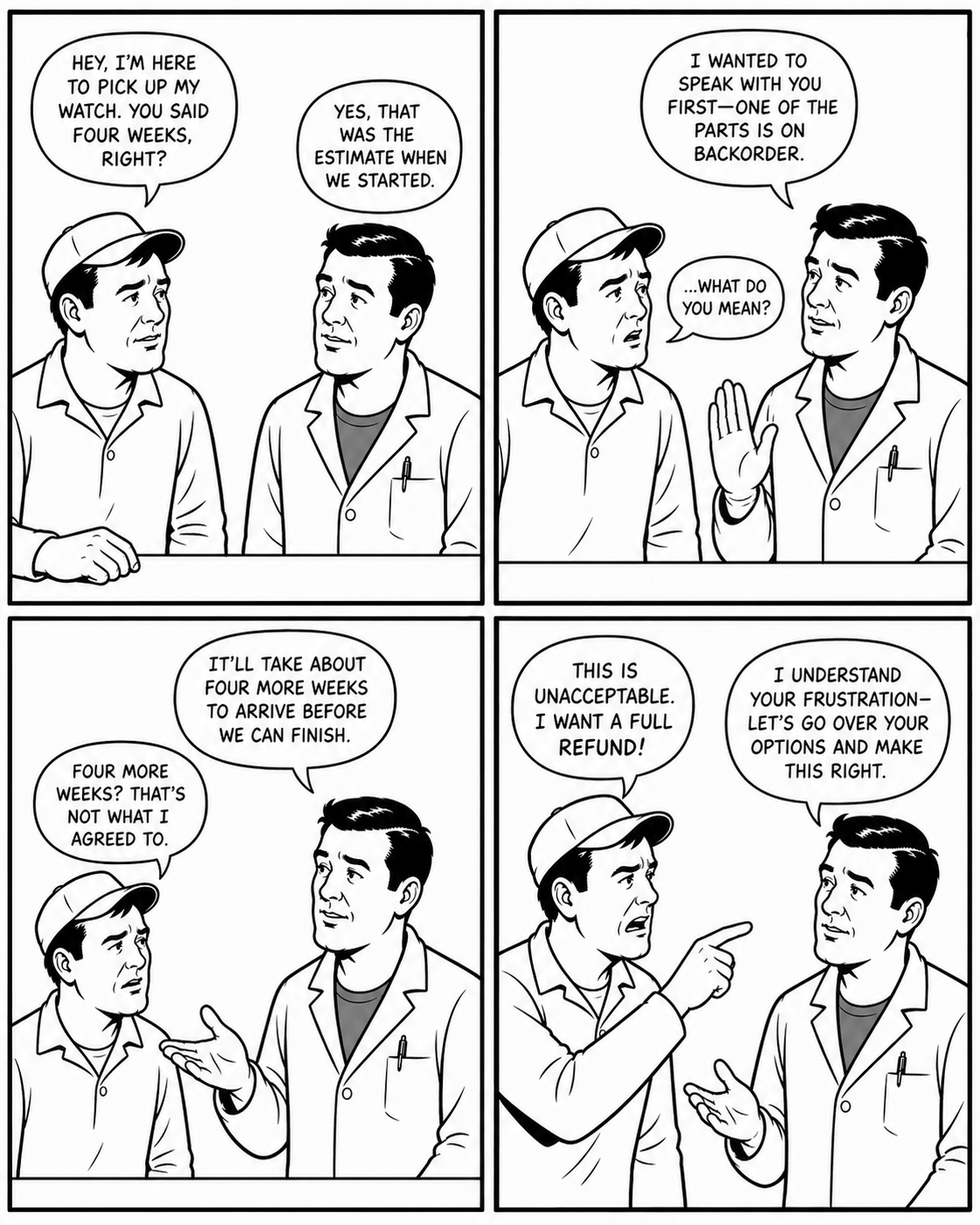
A client called me at week 3. "Is the watch done yet?"
The part was on backorder, four-week ETA. His tone shifted on the call. The watch was a gift. There was a deadline I didn't know about.
The delay wasn't the problem. The silence was.
The principle
Backorders are part of this trade. Vintage calibers, obscure movements, discontinued references, international suppliers running on their own clock. You can't always control when a part arrives. You can always control whether the client feels informed.
A client who hasn't heard from you in two weeks has already decided something went wrong. They fill silence with anxiety, and that anxiety becomes a phone call, an email, sometimes a demand to return the watch unrepaired. The delay didn't damage trust. The silence did.
Done well, a parts delay can actually strengthen the relationship. Clients who experience real professional communication during a hiccup often become the most loyal referral sources. More on that at the end.
Order parts fast. This part is on you.
Before we get to communication, the prerequisite: order the part fast.
If you quote four weeks and don't place the parts order until week three, no communication protocol will save you. Parts should go on order within 1 to 2 days of customer approval. Same day if possible. The clock the client is watching starts the moment they say yes, not the moment you finally get around to placing the order.
Losing a customer and a sale because a parts order sat in your inbox is never good for business.
The four-touchpoint protocol
1. At intake
Before the watch leaves the customer's hand, disclose the reality. Some jobs require parts sourcing. Some parts come in a week, some take months. Set a slightly conservative timeline so you have room to deliver early.
The honest framing: "I'll know more after I open it up. If we need parts, lead times can vary, and I'll give you a real ETA the moment I order them."
This single sentence at intake prevents 80 percent of frustrated calls down the line.
2. At order placement
The same day you place the order, message the client. Don't wait until you have a status update. The status update is the message.
A working template:
Subject: Update on your [watch] — part ordered
Hi [Name],
Quick update on your [reference / model]. I've ordered the [part] needed to complete the service. Estimated arrival is [date], and I'll message you the moment it comes in with a finish date.
If anything shifts on the supplier's end, I'll let you know right away.
Thanks for your patience, Francis
What to include: the part is ordered, the ETA, and a promise to update on arrival. What to leave out: supplier drama, your frustration with the distributor, technical detail the client didn't ask for. Professional tone, short, specific.
3. Mid-wait check-in
If the wait runs past two weeks, send a brief check-in even when you have no new information. Especially when you have no new information.
Hi [Name], wanted to send a quick note that your [watch] is still in the queue waiting on the [part]. No update from the supplier this week, but I'm tracking it and you'll hear from me the moment it lands.
This message takes 30 seconds to send and prevents the call you would otherwise spend ten minutes managing. Silence is the enemy. A client who knows you're tracking the job feels respected. A client who hasn't heard from you assumes you forgot.
4. At part arrival
The moment the part comes in, notify the client. Lead with the energy of good news, because it is good news.
Hi [Name], the [part] for your [watch] arrived today. I'm scheduling the work this week and expect to have it ready for pickup by [date]. I'll confirm once it's complete and tested.
Fresh ETA, clear next step, brief.
Setting expectations when you genuinely don't know
Some parts you simply cannot quote. NOS for a vintage caliber. A discontinued reference. A part that has to come from a specific overseas supplier with unpredictable shipping.
Don't invent a timeline to make the client feel better. The honest version works better:
"This part is harder to source. I have two suppliers I'll reach out to, and realistic lead times can range from two weeks to two months depending on availability. I'll know more within a few days of placing the inquiry, and I'll keep you updated either way."
A client who hears this and chooses to proceed has agreed to the uncertainty. That's a different relationship than one where you promised four weeks and the part takes three months.
When the part is genuinely unavailable
Sometimes a part can't be sourced. The supplier is out, the reference is discontinued, the NOS market has dried up. The instinct is to delay the conversation, hoping something turns up. Don't.
The communication when this happens:
Hi [Name], wanted to reach out with an honest update on your [watch]. The [part] I need has proven harder to source than I expected — both of my usual suppliers are out, and I haven't been able to locate one elsewhere. Here are the options I see:I can keep searching. Sometimes a part surfaces after weeks or months. No guarantee.There's a serviceable alternative — [describe]. It would [trade-off honestly stated].I can return the watch to you in its current state, no charge for the diagnostic time.
Happy to talk through which makes the most sense for you.
Honesty, options, no pressure. Some clients will wait. Some will take the alternative. Some will take the watch back, and in my experience those clients still come back later because you didn't oversell them.
The long game
The smooth job that never hiccupped is forgettable. The job where something went sideways and the watchmaker handled it with clear, proactive communication, that one gets talked about.
Clients tell their friends about the watchmaker who messaged them every two weeks during a long backorder. They don't tell their friends about the watchmaker whose service went exactly as expected. Difficulty handled well builds more trust than easy work that never tested the relationship.
A parts delay is a chance to demonstrate that you run a real shop. Take it.
A note on workflow
Doing this manually for every job takes time. Drafting the same intake message, the same order-placed message, the same mid-wait check-in, customized to each client and each job, eats hours a week. That's the gap Watchmaker App's status update workflow is built to close. The touchpoints get sent automatically against the job's actual status, the client gets a professional update on schedule, and you stay on the bench instead of in your email.
The protocol works whether you use the app or not. The app just makes it sustainable at volume.
What's your system?
I'm genuinely curious how other shops handle this. Email templates? Text messages? A whiteboard with reminders? Reply and let me know what's working — I'll share the best answers in a future issue.
— FZ