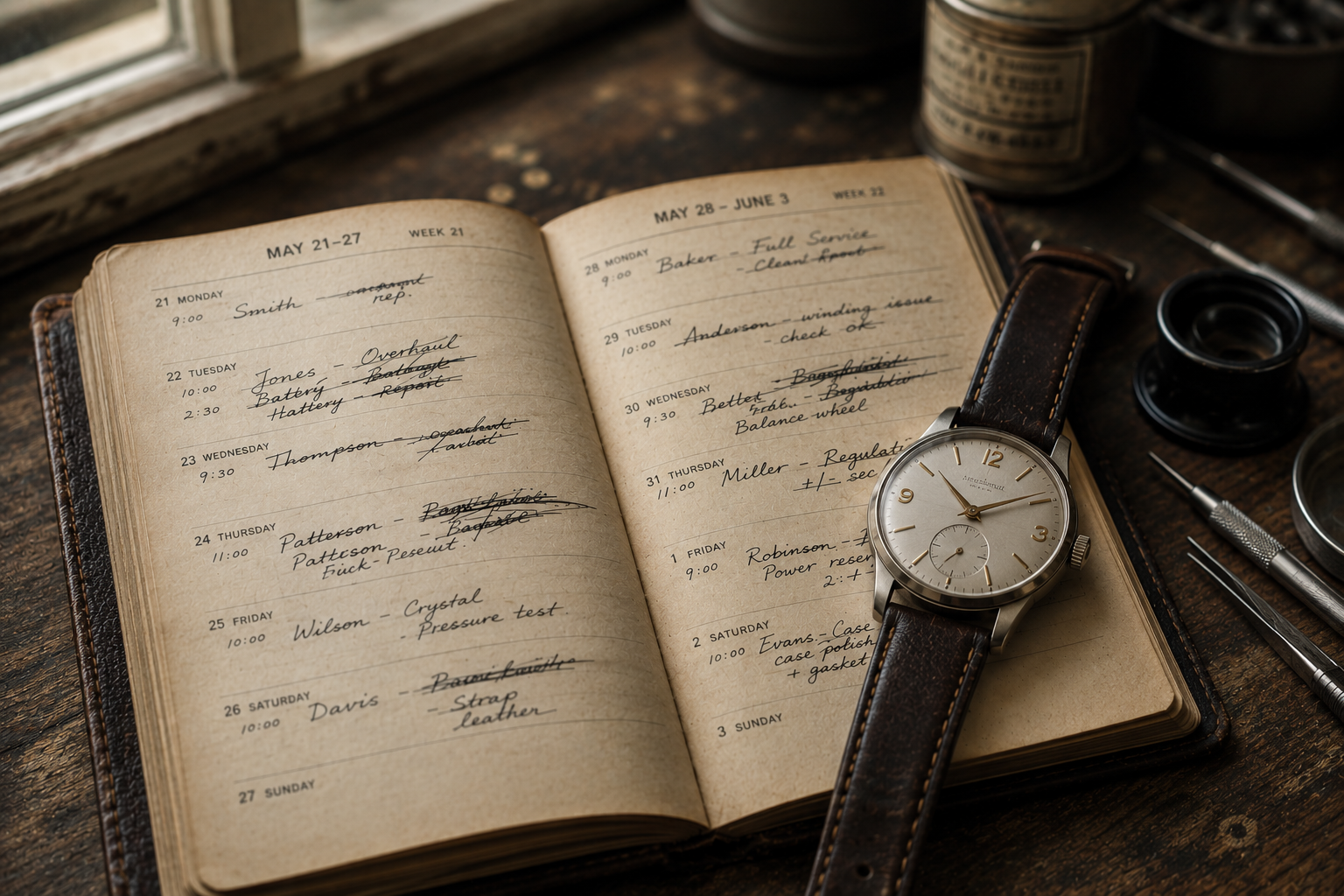
The Watch in the Drawer

Is there a watch sitting somewhere in your home right now that belonged to someone you love?
There almost always is.
I want to tell you about one of them.
A client came in last spring with a small gold watch in a velvet pouch. It had been her mother's. Worn every day, she told me, until her mother got sick and her wrist got too thin for the bracelet. Then it went into a drawer. That was eleven years ago.
She didn't really expect me to fix it. She brought it in because her mother's birthday was coming up and she wanted to know, one way or another, what the situation was.
I opened it up at the bench. A Bulova caliber from the late sixties, not rare, but well made. The mainspring had set. The lubricants were dry and a little gummy where they hadn't fully evaporated. The faintest haze of dust on the dial side. Nothing catastrophic. Nothing I hadn't seen a hundred times.
I told her it could be saved.
When she came to pick it up two weeks later, I had it running on a timing machine on the counter so she could see it before I handed it back. She didn't say anything for a second. Then she put it on her wrist and just sat there with her hand against her cheek, listening.
That moment is the reason I do this job.
A watch in a drawer is not being preserved.
There's a story most people believe about watches that go into drawers, which is that they're being kept safe. They aren't. They're slowly going out of spec.
Mechanical watches were designed to run. The lubricants in the movement are formulated to stay put while moving parts pass through them. When the watch sits still for years, those oils don't hold their place forever. They migrate. They oxidize. The synthetic ones can polymerize into something closer to varnish than oil. The natural ones, in older watches, can simply dry out.
Gaskets harden. Dust drifts in through case seams that are no longer sealing properly. Mainsprings that were left wound take a set and lose torque.
Time is the enemy of stillness in a watch. Not of wear.
The good news is that almost none of this is permanent. A service can replace lubricants, gaskets, mainsprings, crystals, crowns. A watch that's been quiet for twenty years can usually run again.
Vintage women's watches are their own thing.
Most older ladies' watches are smaller and more delicate than men's pieces from the same era. The movements are sometimes shaped to fit unusual case profiles. Oval, tonneau, rectangular. Parts can be harder to source. The dials are often more fragile because they were designed to be beautiful first and serviceable second.
I find them more technically interesting to work on than most modern watches, honestly. The constraint of fitting a working movement into a small or unusual case forces a lot of creativity from the original designers. You see things you don't see in a 40mm dive watch.
It also means service on a vintage women's watch can take a little longer, and sometimes requires sourcing parts from specialists. Worth knowing going in.
How to know if it's worth servicing.
Most heirloom watches are worth bringing in for at least an honest look. The conversation I usually have with clients goes something like this.
What's the sentimental weight? If this is your grandmother's watch and you intend to wear it, that's one decision. If it's a piece you want preserved as a keepsake without ever running, that's a different one. Both are valid.
What's the condition? Some watches have damage that costs more to repair than the watch is worth on the open market. That's almost never the right way to make the decision with a family piece, but you should know.
Wearable, or looking right? Sometimes those are different jobs. A full service makes a watch wearable. A restoration makes it look the way it did when it was given. Different jobs, different price tags.
I'd rather have that conversation honestly up front than surprise someone with the bill at the end.
If you're bringing in a family piece, here's what helps.
A few things make this easier for whoever is going to service it.
Tell us what you know about the history. When it was bought, where it came from, who wore it, when it stopped running. Even fragments help.
Tell us what matters to you about the outcome. Wearable is the default assumption, but it isn't always right. If the patina on the dial matters to you, say so before we open the case.
Mention any known damage or prior repair. If someone dropped it in 1987 or tried to fix it on a kitchen table, we want to know.
And please don't try to clean it yourself.
Mother's Day is May 10.
Don't wait until it's too late. Find your favorite watchmaker in town and get it on the bench.
If you have a family watch sitting somewhere right now, send me a photo and the story behind it. Whose it was. What you know about it. I'd like to feature a few in the next issue.
— FZ