Are you a watchmaker?
Every watchmaker eventually has to answer a question that has nothing to do with watches: what is your time actually worth?
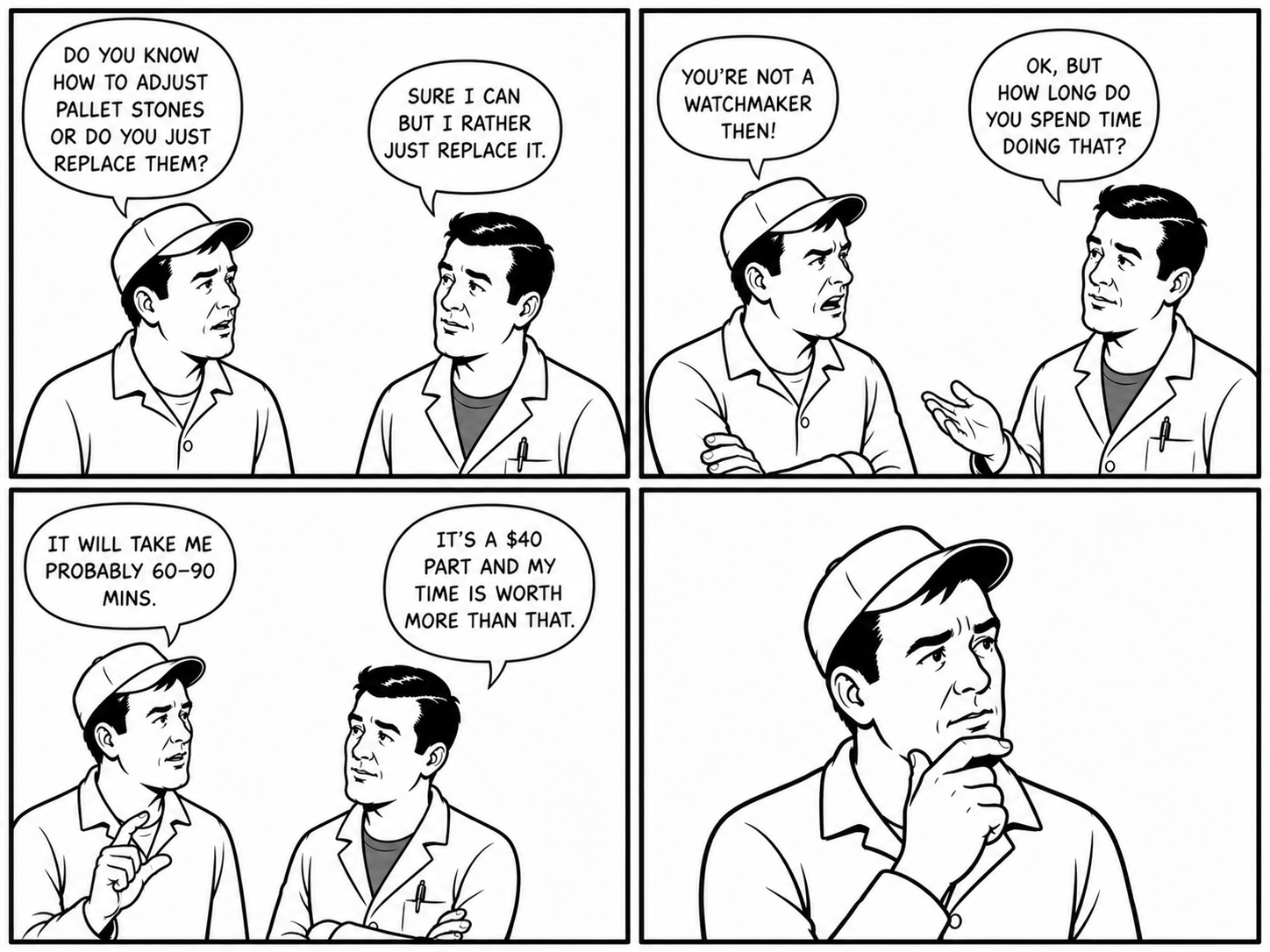
The old-school view is that a watchmaker who replaces instead of adjusts isn't really practicing the craft. You should be able to manipulate the escapement. Move the stones. Tune the lock and drop. That's the work. Anyone can swap a part.
I get it. I was trained that way too. There's real pride in fixing something at the component level instead of the assembly level.
But here's the part nobody talks about.
Time at the bench has a price. A pallet fork with stones is around $40. Adjusting the existing stones takes me, on a good day, an hour. Sometimes longer. If I bill that hour at my shop rate, I just charged the customer significantly more than the part costs, to do something that ends up at the same outcome. A watch that runs.
So which one is being a watchmaker?
The guy who can do everything but loses money on every job?
Or the guy who knows when to use the skill and when to put it away?
The honest answer is that both are right, just about different things.
The first guy is right that the skill matters. If you can't adjust pallet stones, you're going to be stuck the day you can't get the part. You're going to misdiagnose escapement issues. You're going to be a parts swapper, not a watchmaker, and eventually a customer with an unusual movement walks in and you have nothing to offer them.
The second guy is right that running a shop means knowing the cost of every minute. The bench is a business. If the math doesn't work, the doors don't stay open, and then nobody gets their watch fixed at all.
The mistake is treating these as opposing values. They aren't. The skill earns you the option to choose. Without it, you don't have a decision, you have a default.
So the real answer to "are you a watchmaker?" isn't whether you adjust or replace. It's whether you actually know which one this job calls for.
—FZ